AliNet
gated multi-hop GNN
Knowledge Graph Alignment Network with Gated Multi-hop Neighborhood Aggregation Zequn Sun, Chengming Wang, Wei Hu, Muhao Chen, Jian Dai, Wei Zhang, Yuzhong Qu - AAAI 2020 Paper |
models/alinet.py| notebook
Idea in one sentence
Two aligned entities often have non-isomorphic 1-hop neighbourhoods, so AliNet also aggregates the 2-hop neighbourhood (with attention) and fuses the two scales with a learned gate.
Architecture
%%{init: {'theme':'base','themeVariables':{'fontSize':'14px','fontFamily':'Inter, sans-serif','lineColor':'#7d8590','primaryTextColor':'#e6edf3'}}}%%
flowchart LR
    H["entity features H"] --> G1["1-hop GCN<br/>g1 = A_hat (H W1)"]
    H --> G2["2-hop attention<br/>g2 = sum_k alpha_ik W2 h_k"]
    G1 --> GATE["gate sigmoid(g1 W_g)"]
    GATE --> OUT["out = gate . g1 + (1-gate) . g2"]
    G2 --> OUT
    OUT --> JK["JK concat (layer outputs)<br/>L2-normalised"]
    JK --> AL["margin align + TransE anchor"]
    classDef b fill:#0c2d6b,stroke:#58a6ff,stroke-width:2px,color:#dbeafe;
class H,G1,G2,GATE,OUT,JK,AL b;Components
- 1-hop aggregation over the symmetrically normalised adjacency \(\hat{A} = \tilde{D}^{-1/2}(A+I)\tilde{D}^{-1/2}\).
- 2-hop attention over capped/sampled 2-hop edges (distant neighbours are noisier).
- Gate that learns to blend the 1-hop and 2-hop signals.
- Relation-aware (TransE) loss \(\lVert z_h + r - z_t\rVert\) on the GNN representations - a structural anchor for every entity, not just the 11% seeds.
- The representation is the JK concatenation of layer outputs (not the raw embedding).
Losses
Margin-ranking alignment with mixed epsilon-truncated hard negatives:
\[\mathcal{L}_{\text{align}} = \big[\, \text{margin} + d(x,y) - d(x, y^-) \,\big]_+ \quad(\text{+ left})\]
plus the relation anchor on sampled triples:
\[\mathcal{L}_{\text{rel}} = \big[\, \text{margin} + \lVert z_h + r - z_t\rVert - \lVert z_h + r - z_{t^-}\rVert \,\big]_+\]
Results
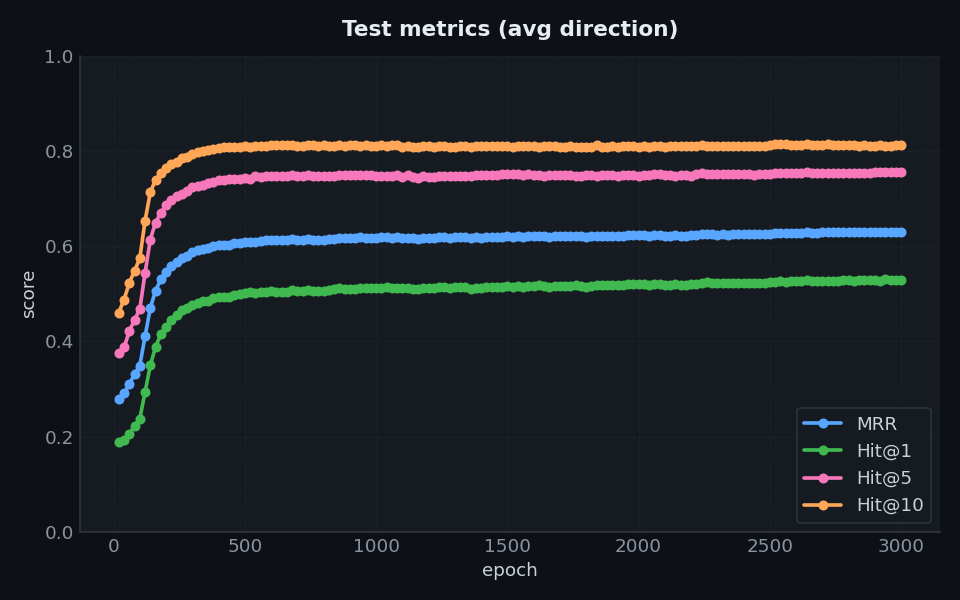
DBP15K zh_en, 30% seed.
| Hit@1 | Hit@10 | MRR | |
|---|---|---|---|
| AliNet (paper) | 0.539 | 0.826 | 0.628 |
| This repo | ~0.53 | ~0.81 | ~0.63 |
Debugging lessons (the decisive ones)
- Linear propagation (no ReLU between layers): a ReLU GCN caps at ~0.20 Hit@1, the linear version reaches ~0.40 - the ReLU destroys the structural signal.
- Relation-aware loss is the decisive link: it anchors all entities (MeanRank 200 -> 75). Without it, the model plateaus at the GCN-Align level.
- JK = layer outputs only: including the raw per-entity embedding lets the model memorise seeds (train Hit@1 = 1.0, test ~ 0).
- Hard negatives are harmful without the relation anchor (they scatter the tail) and beneficial with it (Hit@1 0.45 -> 0.53).
- 2 layers (3+ over-smooths); 2-hop attention is chunked for memory.
References
- Sun et al., AliNet, AAAI 2020.
- Wang et al., GCN-Align, EMNLP 2018.
- Lample et al., CSLS, ICLR 2018.