BootEA
structural + bootstrap
Bootstrapping Entity Alignment with Knowledge Graph Embedding Zequn Sun, Wei Hu, Qingheng Zhang, Yuzhong Qu - IJCAI 2018 Paper |
models/bootea.py| notebook
Idea in one sentence
Learn alignment-oriented TransE embeddings (AlignE), make aligned pairs share relational context by swapping them in each other's triples, and grow the training set with an editable, recomputed mutual one-to-one matching.
Architecture
%%{init: {'theme':'base','themeVariables':{'fontSize':'14px','fontFamily':'Inter, sans-serif','lineColor':'#7d8590','primaryTextColor':'#e6edf3'}}}%%
flowchart LR
    T["triples (base + swapped)"] --> KGE["AlignE TransE<br/>||h + r - t||"]
    S["seed pairs (e1,e2)"] --> SWAP["swap entities<br/>(e1,r,t) -> (e2,r,t)"]
    SWAP --> T
    KGE --> EMB["entity embeddings<br/>(unit sphere)"]
    S --> PULL["limit-based pull"]
    EMB --> BOOT["MWGM mutual matching<br/>(recomputed)"]
    BOOT -. "pseudo pairs" .-> PULL
    EMB --> EVAL["CSLS eval"]
    classDef b fill:#0c2d6b,stroke:#58a6ff,stroke-width:2px,color:#dbeafe;
class T,KGE,S,SWAP,EMB,PULL,BOOT,EVAL b;Components
- AlignE embedding. TransE with a limit-based loss (absolute margins) and entities constrained to the unit sphere; relations are free.
- Epsilon-truncated negatives. Triples are corrupted with the entity's nearest same-KG neighbours (hard negatives), refreshed periodically.
- Alignment by swapping. For a labelled pair \((e_1, e_2)\), swapping the two entities in each other's triples makes them share relational context, pulling their embeddings together - the core of BootEA.
- Editable MWGM bootstrapping. A mutual one-to-one matching over the unlabelled pool, recomputed from scratch each round, so wrong pairs are dropped as the model improves.
Loss
plus a light limit-based pull on the labelled pairs. There is no neighbourhood aggregation - the representation is just the normalised entity embedding (this is what distinguishes BootEA from NAEA).
Training recipe
| Lever | Setting |
|---|---|
model.embed_dim |
75 (paper) |
train.pos/neg_margin_kge |
limit-based margins \(\gamma_1, \gamma_2\) |
train.swapping.cap_per_role |
cap on swapped triples per entity |
train.bootstrap.threshold |
confidence to accept a pseudo pair |
train.eps_truncated.num_candidates |
hard-negative pool size |
Swap only the gold seeds
Swapping is restricted to the gold seed pairs. Letting bootstrapped (possibly wrong) pairs generate swapped triples corrupts the triple set and collapses training.
Results
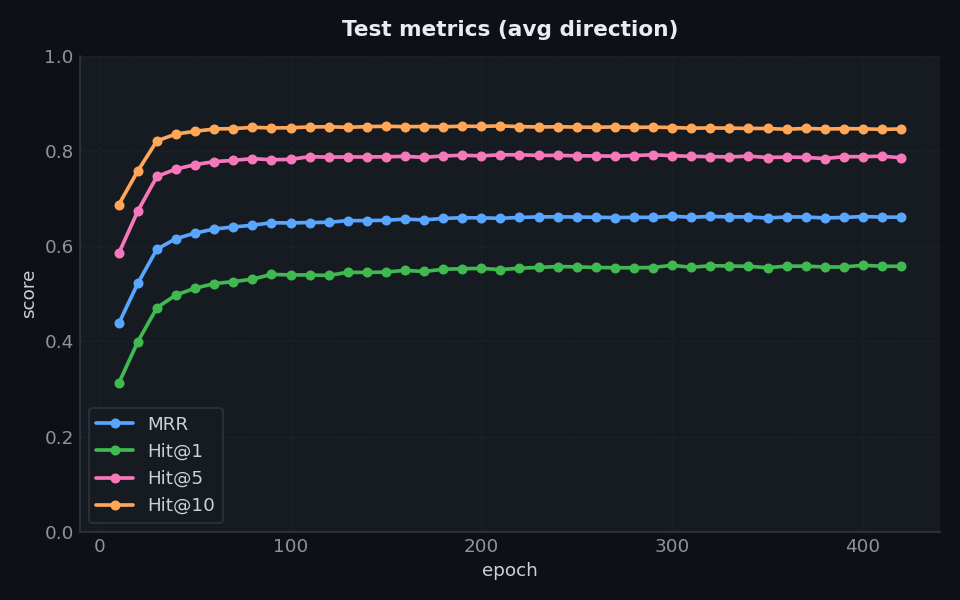
DBP15K zh_en, 30% seed.
| Hit@1 | Hit@10 | MRR | |
|---|---|---|---|
| BootEA (paper) | 0.629 | 0.847 | 0.703 |
| This repo | ~0.56 | ~0.85 | ~0.66 |
Debugging lessons
- The reliable Hit@1 driver here is the contrastive alignment loss with hard negatives, not the swapping alone.
csls_ktuning at evaluation gave a measurable lift.- Hit@10/MRR essentially match the paper; the residual Hit@1 gap is the known hard-to-match part for purely structural models.
References
- Sun et al., BootEA, IJCAI 2018.
- Bordes et al., TransE, NeurIPS 2013.
- Lample et al., CSLS, ICLR 2018.