JAPE
TransE + attributes
Cross-lingual Entity Alignment via Joint Attribute-Preserving Embedding Zequn Sun, Wei Hu, Chengkai Li - ISWC 2017 (the paper that introduced DBP15K) Paper |
models/jape.py| notebook
Idea in one sentence
Run TransE on a merged-seed graph (aligned seeds share one id, bridging the two KGs) and fuse the structure similarity with a cross-KG TF-IDF attribute similarity at scoring time.
Architecture
%%{init: {'theme':'base','themeVariables':{'fontSize':'14px','fontFamily':'Inter, sans-serif','lineColor':'#7d8590','primaryTextColor':'#e6edf3'}}}%%
flowchart LR
    M["merged-seed graph<br/>(aligned seeds share id)"] --> SE["Structure Embedding<br/>TransE ||h+r-t||"]
    A["attribute bags<br/>(sup_attr_pairs merges predicates)"] --> AE["TF-IDF cosine"]
    SE --> FUSE["sim = beta*SE + (1-beta)*AE"]
    AE --> FUSE
    FUSE --> CSLS["CSLS"]
    CSLS --> EVAL["MRR / Hit@k"]
    classDef b fill:#7c2d54,stroke:#f778ba,stroke-width:2px,color:#ffe4f0;
class M,SE,A,AE,FUSE,CSLS,EVAL b;Components
- Structure Embedding (SE). Plain TransE over both KGs in one merged graph; because aligned seeds share ids, TransE propagates the alignment to the test entities.
- Attribute Embedding (AE). A cross-KG, shared-vocabulary bag of attribute predicates;
sup_attr_pairsmerges the zh<->en predicates so the vocabularies overlap. TF-IDF cosine similarity refines SE. - Fusion + CSLS. \(\text{sim} = \beta\,\text{SE} + (1-\beta)\,\text{AE}\) with \(\beta = 0.9\) (SE-dominant), then CSLS on the fused matrix.
Results
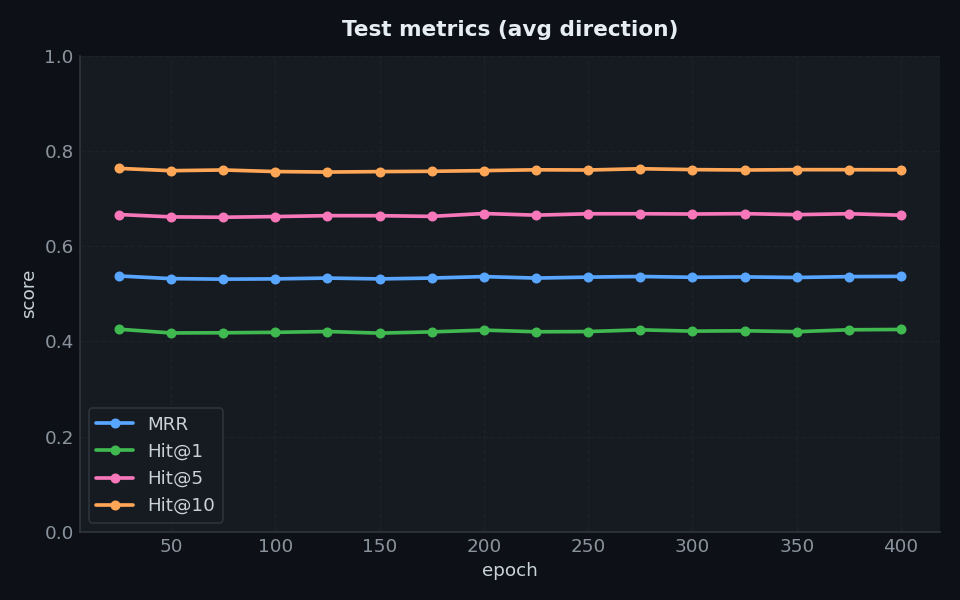
DBP15K, 30% seed. This repo meets or beats the paper on all three pairs.
| Pair | Hit@1 (paper) | Hit@1 (here) | Hit@10 (paper) | Hit@10 (here) | MRR (paper) | MRR (here) |
|---|---|---|---|---|---|---|
| zh_en | 0.412 | 0.425 | 0.745 | 0.761 | 0.490 | 0.537 |
| ja_en | - | 0.368 | - | 0.735 | - | 0.490 |
| fr_en | - | 0.311 | - | 0.705 | - | 0.442 |
Debugging lessons
- Merged-seed format (
use_mtranse_format: false) is essential: SE alone already reaches ~0.31 Hit@1 because the shared ids bridge the two KGs. - AE must be a refiner, not an equal: \(\beta = 0.5\) degrades SE (the TF-IDF and SE cosines are on different scales). \(\beta = 0.9\) realises the attribute gain (~+11 Hit@1).
- CSLS on the fused matrix adds another ~+7 Hit@1.
- Without merging predicates via
sup_attr_pairs, the two attribute vocabularies barely overlap and the AE channel is useless.
References
- Sun, Hu, Li, JAPE, ISWC 2017.
- Bordes et al., TransE, NeurIPS 2013.
- Lample et al., CSLS, ICLR 2018.