NAEA
structural + attention
Neighborhood-Aware Attentional Representation for Multilingual Knowledge Graph Entity Alignment Qiannan Zhu, Xiaofei Zhou, Jia Wu, Jianlong Tan, Li Guo - IJCAI 2019 Paper |
models/naea.py| notebook
Idea in one sentence
Represent each entity by fusing its own embedding with an attentional summary of its neighbourhood, where each neighbour message is made translation-consistent with TransE, then pull aligned pairs together with a saturating margin loss and hard negatives.
Architecture
%%{init: {'theme':'base','themeVariables':{'fontSize':'14px','fontFamily':'Inter, sans-serif','lineColor':'#7d8590','primaryTextColor':'#e6edf3'}}}%%
flowchart LR
    E["entity e"] --> SELF["self embedding"]
    N["neighbours (r_k, e_j, dir)"] --> MSG["messages<br/>m_k = e_j + sign . r_k"]
    MSG --> ATT["GAT attention<br/>alpha_k = softmax(LeakyReLU(a^T[W e || W m_k]))"]
    ATT --> NB["e_hat = sigmoid(sum_k alpha_k W m_k)"]
    SELF --> Z["z = e + e_hat<br/>(L2-normalised)"]
    NB --> Z
    Z --> AL["alignment loss + TransE"]
    classDef b fill:#0c2d6b,stroke:#58a6ff,stroke-width:2px,color:#dbeafe;
class E,N,MSG,ATT,NB,SELF,Z,AL b;Components
- Relation level (TransE). A margin-ranking loss on \(f(h,r,t)=\lVert h + r - t\rVert\) with negatives corrupted within the same KG, capturing each graph's relational structure.
- Neighbourhood-aware attention. For an entity \(e\), each neighbour contributes a translation-consistent message \(m_k = e_j + \text{sign}\cdot r_k\) (\(+1\) for in-edges, \(-1\) for out-edges, so the message reconstructs \(e\)). A GAT attention weights the neighbours; the neighbourhood embedding is \(\hat{e}=\sigma\!\left(\sum_k \alpha_k\, W m_k\right)\).
- Joint representation \(z = e + \hat{e}\), L2-normalised, used for alignment and evaluation.
Loss
With normalised embeddings the distance lies in \([0, 2]\), so a relative margin collapses the space. NAEA uses a limit-based (absolute-margin) loss that saturates:
Once a negative is far enough (\(d \ge \gamma_2\)) its gradient is zero, so there is no runaway repulsion even with nearest-neighbour (hard) negatives.
Training recipe
| Ingredient | Setting | Why it matters |
|---|---|---|
| Alignment loss | limit-based (absolute margins) | saturates, no collapse |
| Negatives | epsilon-truncated (nearest cross-KG) | the Hit@1 lever |
| Bootstrapping | recomputed every round, never accumulated | avoids error propagation |
| Matching | mutual one-to-one on CSLS | high-precision pseudo labels |
| Eval | CSLS | reduces hubness |
Results
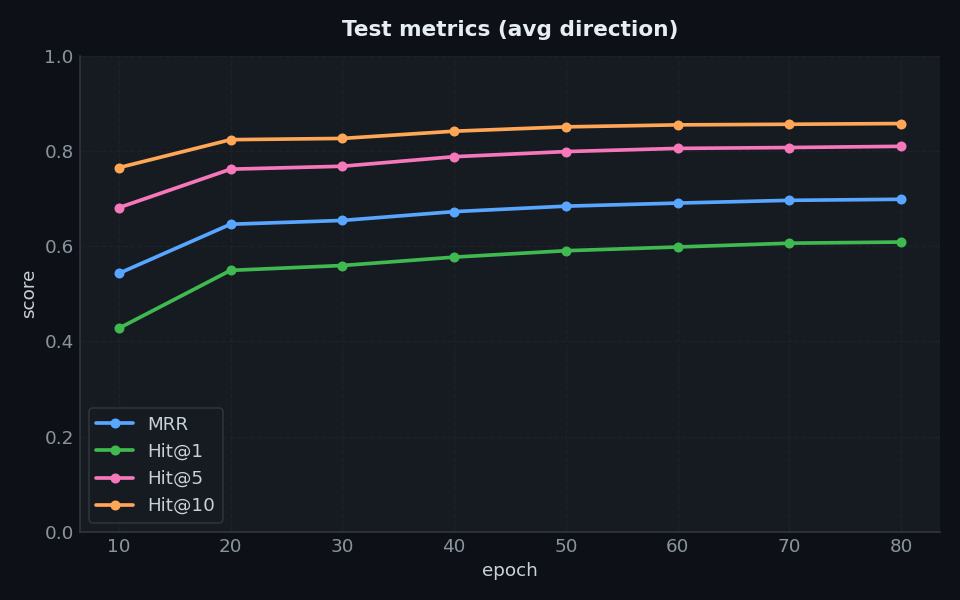
DBP15K zh_en, 30% seed.
| Hit@1 | Hit@10 | MRR | |
|---|---|---|---|
| NAEA (paper) | 0.650 | 0.867 | 0.720 |
| This repo | ~0.62 | ~0.86 | ~0.70 |
Debugging lessons
- A relative margin with normalised embeddings makes MeanRank explode - the limit-based loss is what keeps it stable.
- Accumulated bootstrapping propagates early mistakes and collapses after ~100 epochs; recomputing the pseudo-set from scratch each round fixes it.
- Random negatives become too easy late in training and cap Hit@1; epsilon-truncated hard negatives are the lever.
- NAEA's published numbers are notoriously hard to match - the independent OpenEA benchmark only reaches Hit@1 ~0.31-0.40; this repo lands close to the paper.
References
- Zhu et al., NAEA, IJCAI 2019.
- Bordes et al., TransE, NeurIPS 2013.
- Velickovic et al., Graph Attention Networks, ICLR 2018.
- Lample et al., Word Translation Without Parallel Data (CSLS), ICLR 2018.