GCN-Align
GCN (structure channel)
Cross-lingual Knowledge Graph Alignment via Graph Convolutional Networks Zhichun Wang, Qingsong Lv, Xiaohan Lan, Yu Zhang - EMNLP 2018 Paper |
models/gcnalign.py| notebook
Idea in one sentence
A 2-layer GCN with weights shared across both graphs maps structurally equivalent entities to nearby embeddings; the adjacency is weighted by relation functionality.
Architecture
%%{init: {'theme':'base','themeVariables':{'fontSize':'14px','fontFamily':'Inter, sans-serif','lineColor':'#7d8590','primaryTextColor':'#e6edf3'}}}%%
flowchart LR
    TR["triples"] --> ADJ["functionality-weighted adjacency<br/>M[h,t]+=max(ifun,0.3), M[t,h]+=max(fun,0.3)"]
    ADJ --> NORM["+ self-loops, D^-1/2 M D^-1/2"]
    NORM --> GCN["shared 2-layer GCN<br/>H' = A_hat H W"]
    GCN --> Z["embeddings (L2-normalised)"]
    Z --> L1["L1 margin loss (seed pairs)"]
    Z --> EVAL["L1 / CSLS eval"]
    classDef b fill:#0c2d6b,stroke:#58a6ff,stroke-width:2px,color:#dbeafe;
class TR,ADJ,NORM,GCN,Z,L1,EVAL b;Components
- Functionality weighting. For relation \(r\), \(\text{fun}(r)=\#\text{heads}/\#\text{triples}\) and \(\text{ifun}(r)=\#\text{tails}/\#\text{triples}\). Edge weights accumulate \(M[h,t]\mathrel{+}=\max(\text{ifun}(r), 0.3)\) and \(M[t,h]\mathrel{+}=\max(\text{fun}(r), 0.3)\), then self-loops + symmetric normalisation.
- Shared 2-layer GCN (structure channel SE), linear propagation.
- L1 margin alignment loss with random negatives on both sides.
Loss
\[
\mathcal{L} = \big[\, \lVert z_{e_1}-z_{e_2}\rVert_1 + \gamma - \lVert z_{e_1}-z_{e_2^-}\rVert_1 \,\big]_+ \quad(\text{+ symmetric left side})
\]
Results
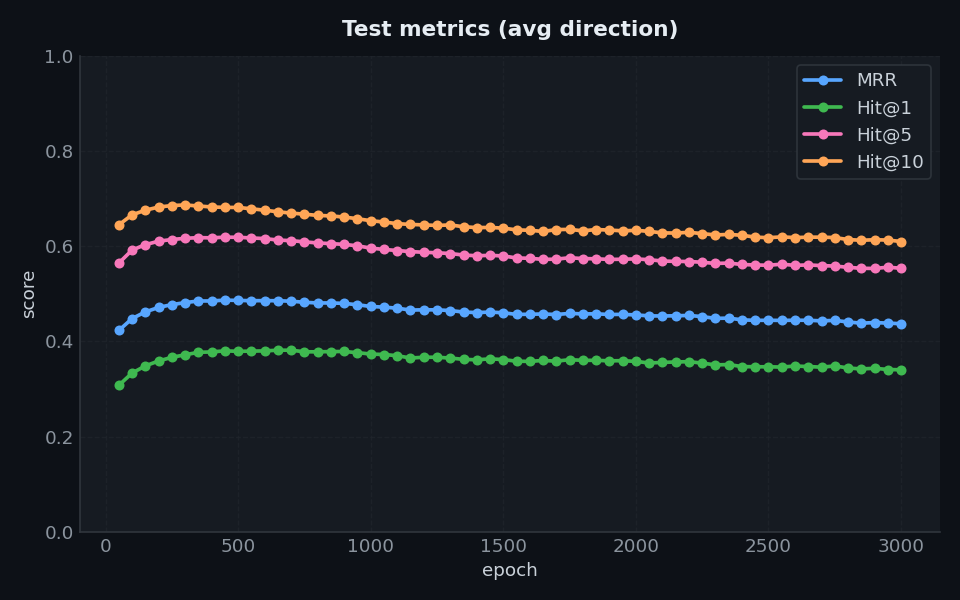
DBP15K zh_en, 30% seed (structure channel SE only).
| Hit@1 | Hit@10 | MRR | |
|---|---|---|---|
| GCN-Align SE (paper) | 0.384 | 0.703 | - |
| This repo | ~0.38 | ~0.68 | ~0.49 |
Debugging lessons
- L2-normalised output: with raw embeddings + SGD lr=20 (paper), training diverges (NaN) in PyTorch; normalising keeps the L1 margin on a bounded scale.
- Linear propagation beats ReLU for alignment.
- k=25 negatives (the paper's k=5 saturates the loss too early); Adam lr 1e-3, ~3000 epochs, keep the best checkpoint (best point is early, then a slight decline).
- dim 300 (paper 200) gains the last Hit@10 points; CSLS at evaluation.
References
- Wang et al., GCN-Align, EMNLP 2018.
- Kipf & Welling, GCN, ICLR 2017.
- Lample et al., CSLS, ICLR 2018.