KECG
GNN + TransE
Semi-supervised Entity Alignment via Joint Knowledge Embedding Model and Cross-graph Model Chengjiang Li, Yixin Cao, Lei Hou, Jiaxin Shi, Juanzi Li, Tat-Seng Chua - EMNLP 2019 Paper |
models/kecg.py| notebook
Idea in one sentence
Train two models that share one entity table: a cross-graph diagonal multi-head GAT that pulls aligned entities together, and a TransE knowledge-embedding loss applied to the GAT outputs, alternating between them.
Architecture
%%{init: {'theme':'base','themeVariables':{'fontSize':'14px','fontFamily':'Inter, sans-serif','lineColor':'#7d8590','primaryTextColor':'#e6edf3'}}}%%
flowchart LR
    EMB["shared entity table"] --> GAT["diagonal multi-head GAT<br/>(combined graph)"]
    GAT --> Z["entity reps z"]
    Z --> CG["Cross-Graph triplet loss<br/>(even epochs)"]
    Z --> KE["Knowledge-Embedding TransE<br/>(odd epochs)"]
    REL["relation table"] --> KE
    Z --> EVAL["CSLS eval"]
    classDef b fill:#3b0764,stroke:#a371f7,stroke-width:2px,color:#f3e8ff;
class EMB,GAT,Z,CG,KE,REL,EVAL b;Components
- Cross-Graph (CG). A multi-head GAT with diagonal weights (a vector per head, not a full matrix), shared across both KGs on one combined graph; ELU between layers, heads averaged. Aligned seeds are pulled together with a triplet margin loss and NNS hard negatives.
- Knowledge-Embedding (KE). A TransE-style loss applied to the GAT outputs (not the raw table), which is what guides the attention layers.
- The two objectives alternate (CG on even epochs, KE on odd).
Losses
Cross-graph triplet margin on the GAT reps, plus a TransE loss that reproduces a quirk of the original repository (it normalises the error vector then sums its components, rather than taking the true L2 distance):
\[
\mathcal{L}_{\text{KE}} = \text{margin-ranking}\Big(\textstyle\sum \widehat{(z_h + r - z_t)},\; \textstyle\sum \widehat{(z_{h'} + r - z_{t'})}\Big)
\]
Results
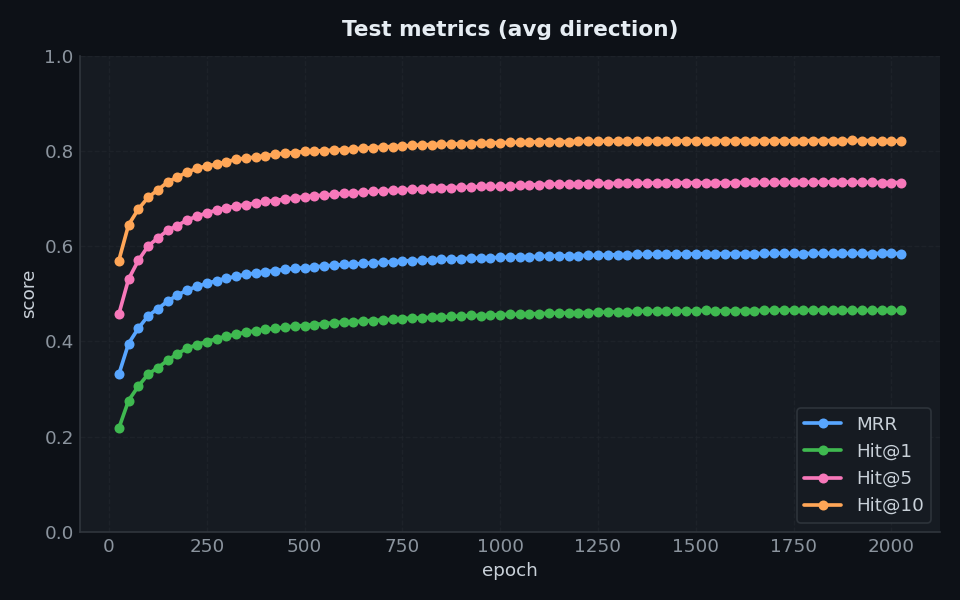
DBP15K zh_en, 30% seed.
| Hit@1 | Hit@10 | MRR | |
|---|---|---|---|
| KECG (paper) | 0.477 | 0.835 | 0.598 |
| This repo | ~0.42 | ~0.73 | ~0.52 |
Debugging lessons
- The original TransE math "bug" matters: summing the components of the L2-normalised error vector (rather than the true distance) is what the reference repo does, and reproducing it is needed to approach the published metrics.
- TransE on the GAT outputs, not on the
nn.Embeddingtable, is what pushes gradient into the attention layers and reshapes the structural encodings. - Full-volume batching for the KE step (the 165k combined edges in one batch) is far better than aggressive mini-batching.
- This repo sits ~0.07 under the paper: the exact sparse-GAT NNS that gives the last points was approximated.
References
- Li et al., Semi-supervised Entity Alignment via Joint Knowledge Embedding Model and Cross-graph Model, EMNLP 2019.